
AI-Native Scientific Discovery
Discover the
Unsearchable.
AI3 Discovery uses artificial intelligence to accelerate discovery across biology, chemistry, and materials science. These fields contain near-infinite possibilities. We build the systems that explore them.
The premise
Biology is a search problem.
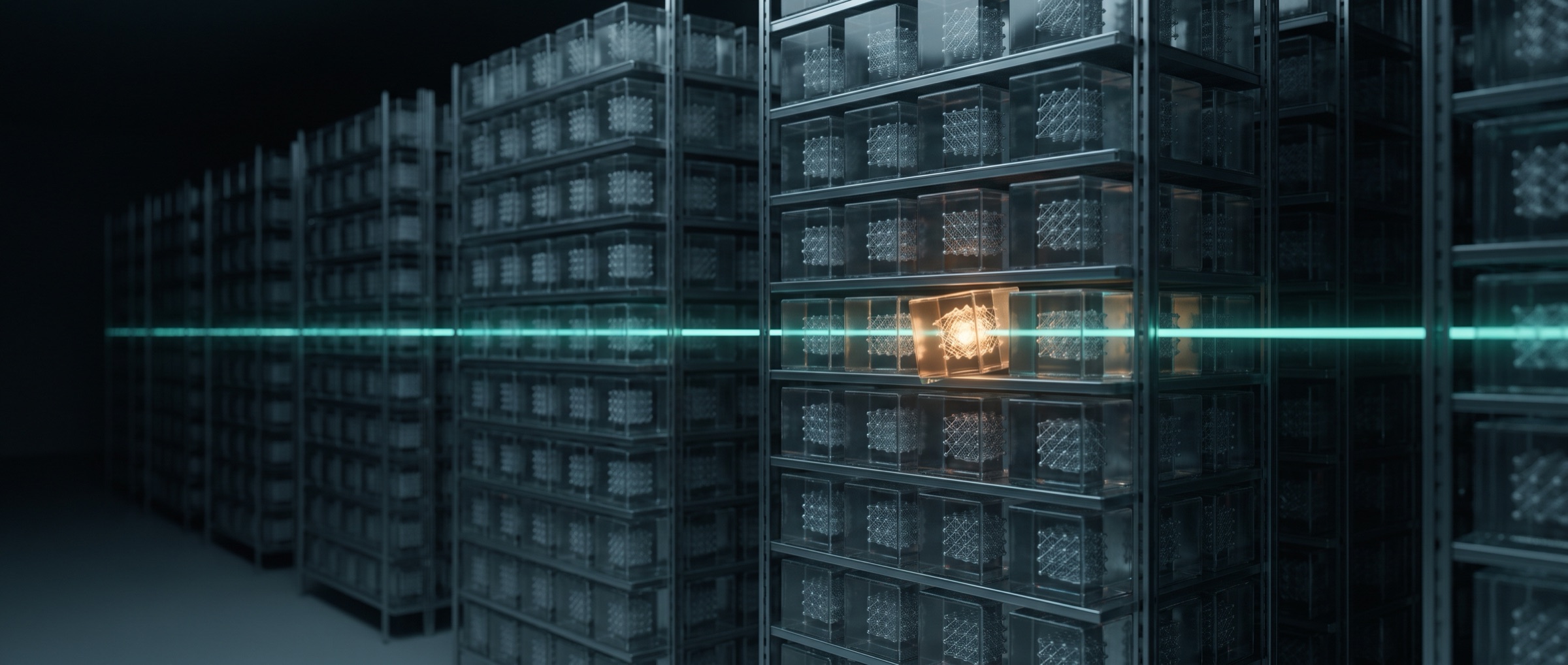
Traditional discovery tests a vanishing fraction of an enormous possibility space. We combine foundation models, biological data, molecular simulation, large-scale compute, and autonomous research agents to explore millions of possibilities before a single physical experiment begins.
Search more.
Learn faster.
Discover better.
Where we search
Some of the spaces we search, each with a harness of its own.
Drug Discovery
Target identification, hit discovery, molecular generation, virtual screening, lead optimization, ADMET, and repurposing.
From billions to a few worth testing → PROTEINSProtein Design
Therapeutic proteins, antibodies, enzyme engineering, binder design, and proteins with no natural neighbour.
From predicting to designing → BIOMARKERSBiomarker Discovery
Patient stratification, disease signatures, response prediction, and multi-omic integration that survives a new cohort.
Signal inside complexity → MATERIALSMaterials Discovery
Batteries, semiconductors, catalysts, polymers, and energy materials, screened in simulation before synthesis.
Discover before making →What we build with
Capabilities we assemble differently for each science.
Foundation Models
Models that read molecular structures, protein sequences, genomes, literature, clinical data, imaging, and materials structures chosen per domain for the data that domain actually has.
Generative Discovery
Rather than scoring a fixed catalogue, our models propose candidates that do not exist yet, optimized against several objectives at once.
Simulation and Prediction
Physics and learned models estimate what an experiment would show, so that the experiments we do run are the ones worth running.
Autonomous Research Agents
Agents read the literature, analyze datasets, form hypotheses, run computational workflows, compare candidates, and keep a memory of what already failed.
Large-Scale Compute
Discovery is bounded by compute. AI3 Discovery runs on the AI infrastructure and large-scale model serving operated by AI3.
Discovery loop
AI × Simulation × Experiment.
Understand
Collect scientific knowledge and biological data.
Generate
AI proposes new hypotheses and candidates.
Predict
Models estimate likely properties and outcomes.
Select
The most promising candidates are prioritized.
Validate
Candidates are tested in simulation or in the lab.
Learn
Results return to the model, and the loop repeats.
Each experiment creates new data. Each new data point improves the next cycle. The result is a research program that compounds instead of a project that ends.
From billions of possible candidates to a small number worth testing.
Why AI3 Discovery
AI-native from day one.
We are not a biotechnology company adding AI to an existing workflow. The workflow was built around AI from the beginning, which is why our unit of work is a discovery cycle rather than a project plan.
AI infrastructure
Deep experience operating large-scale AI systems, model serving, and GPU fleets in production.
Model agnostic
Frontier, open-weight, and domain-specific scientific models are combined and cross-checked rather than chosen once.
Agentic research
Scientific workflows executed, logged, and audited by autonomous agents, including the failures.
Massive parallelism
Thousands of hypotheses evaluated at once, which changes which questions are worth asking.
One standard of proof
A separate harness for every problem we take on, held to the same rules of evidence.
Build the next discovery with us.
We work with pharmaceutical and biotechnology companies, hospitals, universities, research institutes, materials companies, and AI research organizations.