Better predictions from public sequences
AI3 Discovery
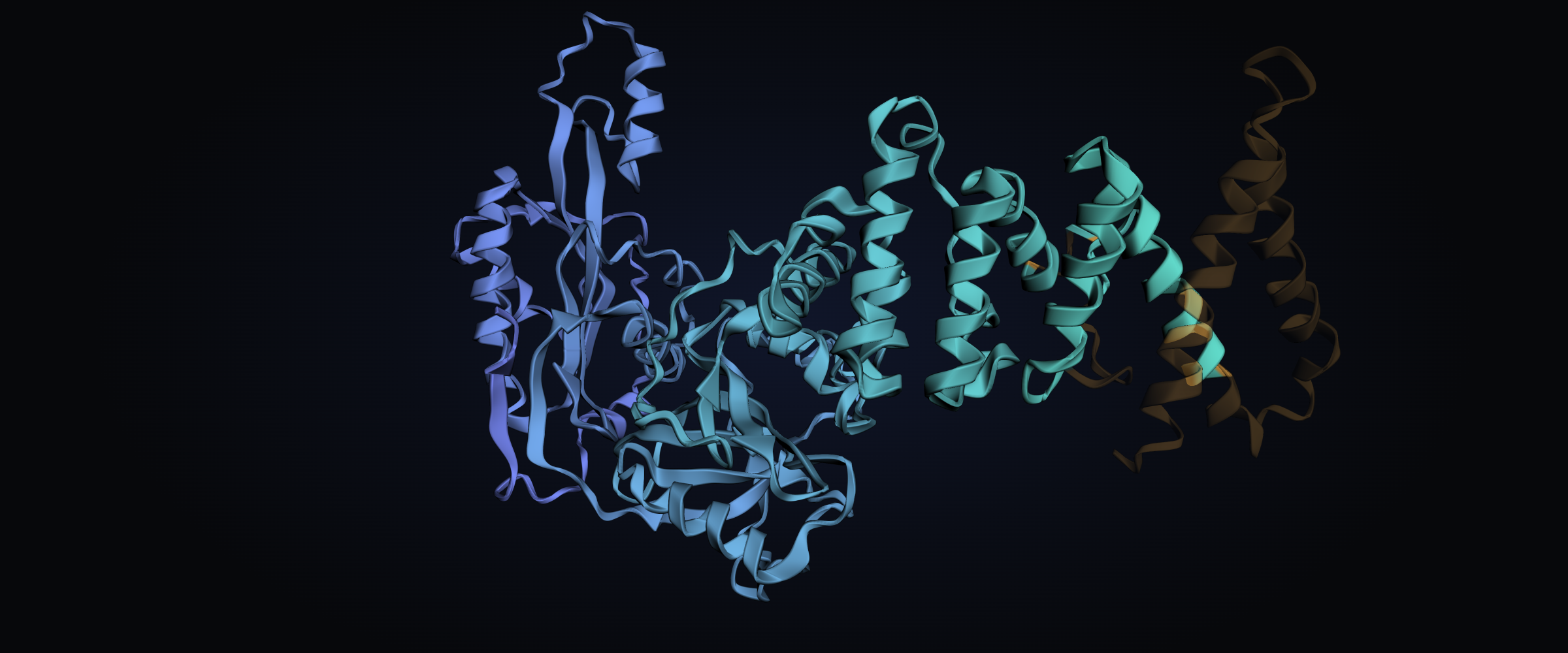
Representative image: the ART_69 partner’s AlphaFold2 prediction, not an experimental structure. Amber marks low-confidence residues; the remaining gradient follows sequence position and does not define domains.
An ART-associated partner protein that was predicted with low confidence using the public server alignment became much more confidently predicted after we added homologous sequences from a public metagenomic resource. For the P2 partner of LPJP1, AlphaFold2 mean pLDDT rose from 38–47 to 80–83. Keeping the same number of family rows but shuffling residues within each row brought it down to 35.
That is the clearest result of this study: we found additional public sequences, enriched the input alignment, and tested the resulting confidence gain against a shuffled-alignment control. In this case, low model confidence reflected more than a property of the protein alone.
The next question was harder. Once a model becomes more confident, does its fold become straightforward to classify? Structure search, sequence profiles and a structure-panel comparison gave different readings of the same predicted proteins. We therefore treated improving a prediction and drawing a biological conclusion from it as separate tasks.
What we measured
Public data supplied a richer input alignment
For poorly characterised proteins such as ART partners, it is easy to stop at the sequences returned by an automated alignment server. We went back to the public Logan resource, retrieved homologues and added them to the server alignments. Prediction confidence increased over substantial parts of the LPJP1 partners, although some regions, particularly their N-termini, remained low-confidence.
This is not a general performance claim for all proteins, nor a new discovery of the importance of alignment depth. The contribution is a target-specific ART study that recovered prediction confidence beyond the default server alignment, then used controls and multiple readouts to examine the gain and its interpretive limits. Without an experimental structure, higher model confidence does not establish higher structural accuracy.
The shuffled control distinguished sequence content from row count
A higher score after alignment enrichment is not enough on its own. Does the improvement arise simply from giving the predictor more rows, or does the information in those rows matter?
We kept the row count, gap pattern and residue composition while shuffling residues within each family row, then repeated the predictions. The confidence gain obtained with real sequences did not recur with the shuffled rows. This supports a contribution from the sequence content, rather than row count and alignment format alone. The control does not separate conservation from co-variation, so it does not establish that the recovered rows contain correct co-evolutionary information.
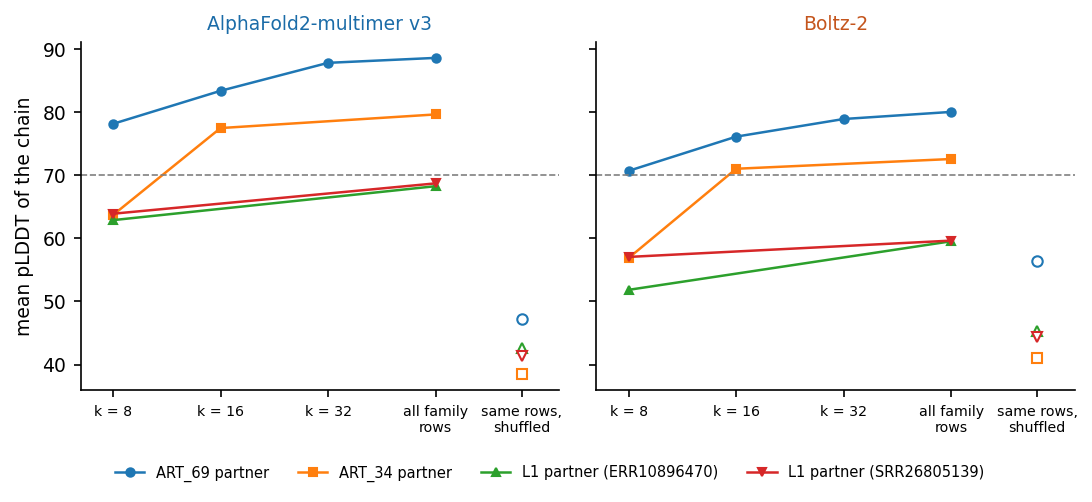
Real homologues and shuffled alignments give different results. We also compared them for partners from additional ART-associated loci. Filled symbols show real family rows; open symbols show the same rows shuffled. The plot retains both the confidence gains and the targets that remained less confidently predicted.
Confident predictions still produced different structural readings
The additional ART_69 partner reached an AlphaFold2 mean pLDDT of 88.4–88.8, with high confidence over most of the chain. This let us extend the comparison beyond the unresolved regions of LPJP1 to a better-predicted partner.
The readings still disagreed. For the additional partners, Foldseek accepted one GNAT-like peak, Pfam GNAT-clan models returned no hit, and the structure panel identified two GNAT-like windows by the registered two-region criterion. Those windows were adjacent and could not distinguish two domains from one longer region.
The study illustrates, in concrete targets, that prediction confidence and domain assignment are different questions. It provides computational material to examine when choosing targets or regions for functional experiments, but does not establish a GNAT domain count or enzyme activity without those experiments.
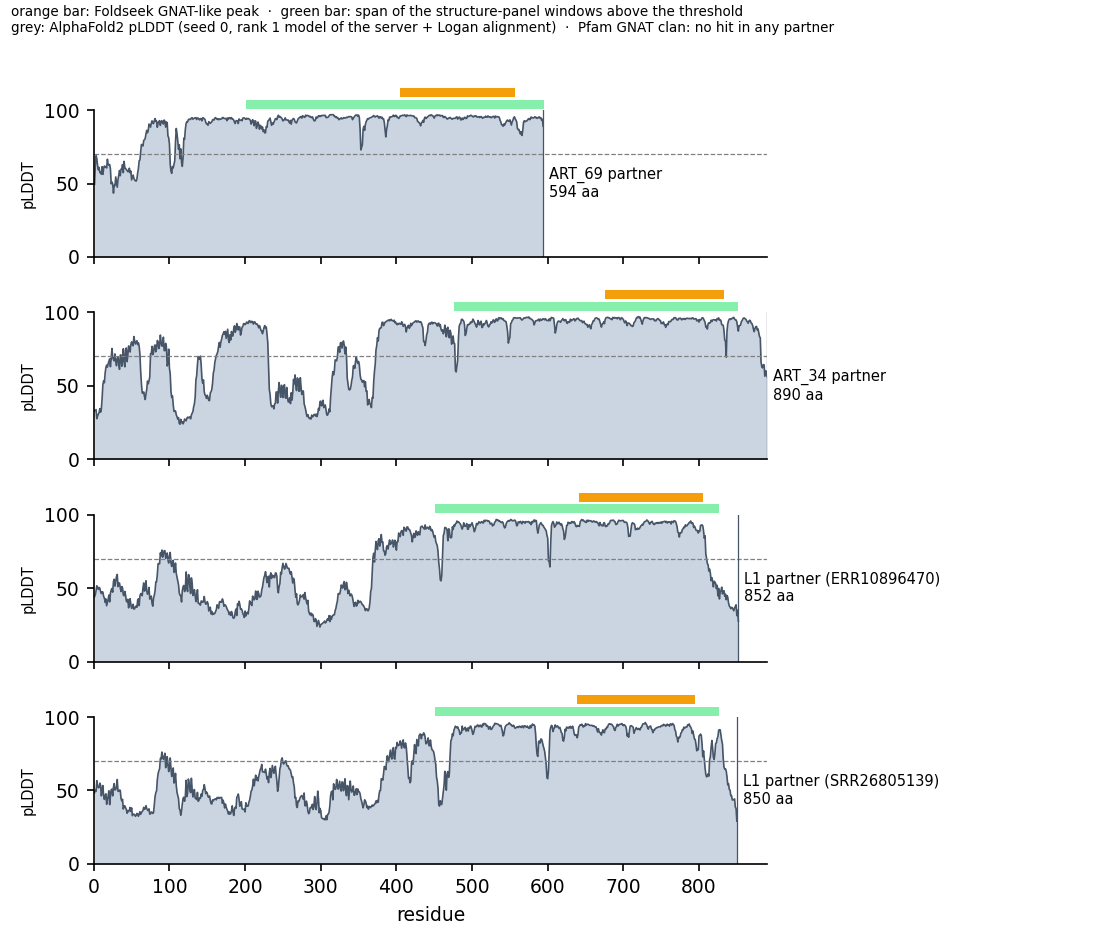
Different methods point to different parts of the same protein. Grey shows prediction confidence, orange the Foldseek peak and green the structure-panel windows. ART_69 is confidently predicted over most of its chain, but the methods do not classify all of those regions in the same way.
Scope of the study
We analysed the two paralogous partners of Listeria phage LPJP1, a family of 91 homologous chains, and 4 complete partners from other ART-associated loci. We supplied alignments to AlphaFold2 and Boltz-2 and read the models with Foldseek, Pfam clan models and a name-free structure-panel comparison. Controls included known GNAT proteins, non-GNAT proteins, depth-matched alignments and row-shuffled alignments.
The family’s exploratory second-region score exceeded the criterion in 55 of 71 scorable chains (55 of all 91). For the additional partners, the registered two-region criterion was met in 24 models. The all-three-seed model set was recorded after the results were read, and the models share alignments across 3 lineages; they were not counted as independent observations.
This is separate from our ART locus-reproduction account. That work located genes and arrays. This study enriched structure predictions for the partner sequences we held and examined how different methods read those predictions.
Why AlphaFold 3 was not used
We did not obtain the official AlphaFold 3 model parameters for this study. The public parameters’ terms of use impose organisation and purpose eligibility conditions separately from the code’s open-source licence. That is not a blanket prohibition on every commercial access route: the current official documentation also points to a separate commercial cloud route, which was not used in this analysis.
Our comparisons changed the input alignment for the same targets within AlphaFold2 and Boltz-2, with control alignments. Not testing AlphaFold 3 does not invalidate those within-predictor comparisons. However, AlphaFold 3 might predict the unresolved regions more confidently or change the structural readings. Low-confidence and unresolved results are scoped to the predictors and settings tested, not to what every newer predictor can achieve. Assessing that possibility would require a separate AlphaFold 3 evaluation with suitable controls. Confidence and detection criteria would also need to be checked on AlphaFold 3 controls rather than transferred directly from the existing engines.
Questions that remain open
The original study’s structural example was ART_57. We could not obtain its accession and did not analyse that protein directly, so this work is not presented as a direct reproduction or refutation of that particular case. Our targets were other partners and homologues with available public sequences.
We established the confidence gain from alignment enrichment and documented disagreement among the structural readings. GNAT domain count and enzyme activity remain unresolved. The work supplies a computational basis for follow-up experiments; it does not replace them. Shared input alignments and differences between target and control alignment depth and regional coverage are also explicitly discussed in the manuscript.
Manuscript and checking data
| Research manuscript and data |
|---|
| English canonical manuscript (PDF) · Korean manuscript (PDF) · Zenodo data for checking the results. This is a self-published research manuscript, not independently human peer reviewed. The PDFs bundled in Zenodo are the 3 October 2026 version; the PDFs linked here are the current corrected manuscript. |
Before publication, separate AI review and audit sessions checked the manuscript against its analysis records and independently recalculated headline quantities from preserved prediction and result files. This audit did not rerun the structure predictions or TM-align’s calculation of per-window scores. Its recomputed and unverified scope is recorded separately. This was not an external human audit or independent human peer review.
Protein sequences, alignments, predicted models and result tables are public on Zenodo under CC BY 4.0. The supplement’s README explains how to reassemble the split archives and verify their hashes. The research data files have not changed through these corrections. Analysis code, calibrated gate files, probe models, harness modules and pre-registration texts are not shared.
| File | Pages | Bytes | SHA-256 |
|---|---|---|---|
| EN PDF | 22 | 943,654 | 460d150701fc3d76994e9444221711bc070f6c0696b388f2b8e18e2c5c8cb5e4 |
| KO PDF | 19 | 1,455,965 | c11392c2b22169556c811e17f281e512f0d1b0c9afcab31e94e9a25bfb914cb8 |
Source study and research harness
Yoon PH, Athukoralage JS, Ameisen E, Kauderer-Abrams E, Perry NT, Durrant MG. Autonomous AI agents discover reverse transcriptases with tandem repeat arrays. Source manuscript. Credit for the original ART discovery belongs to that team.
Research harness and AI use. This study used AI3 Discovery’s scientific research harness to connect public-sequence searches, alignment enrichment, predictions, control analyses and evidence checks with AI coding and analysis agents. Automated checks and AI review do not replace human peer review. AI3 Discovery is responsible for the published account.
| Collaborate with AI3 Discovery |
|---|
| We welcome researchers and laboratories interested in developing computational evidence from public data and connecting it with experiments. Bring a scientific question, a dataset or an experimental direction, and let’s discuss how we can work together. Research and data enquiries: [email protected] |