Could our AI research harness find the DNA sites reported in a published study?
AI3 Discovery built a search harness from the methods and sequence clues in Anthropic’s ART research. When we compared the results retrieved from public data with the paper, 3 initial hits corresponded to illustrated cases. We then improved the harness to reconstruct truncated DNA from the original sequencing reads, bringing further published cases and repeat arrays into view. Similar arrays in a lineage outside the displayed fingerprints also reappeared in samples from different studies.
Candidate search, checks against source data, and reconstruction of missing DNA all worked in real datasets. This ART study shows our harness in action. Here is how the evidence came together.
Could we follow the paper back to the same DNA sites?
Anthropic’s researchers used autonomous AI agents to report array-associated reverse transcriptases, or ARTs. Reverse transcriptases (RTs) generally copy RNA into DNA. The key association in the ART study was an RT gene, a neighboring partner gene, and an upstream repeat array. That arrangement alone does not establish how an ART system works. Credit for the original discovery belongs to the study’s researchers.
A locus is a site in DNA containing the relevant genes and surrounding sequence. Finding a similar protein is one piece of evidence; confirming the neighboring genes and repeat array at its source locus is another. We wanted to reach those array-bearing sites and check the arrangement reported in the paper.
The question was straightforward: could our harness follow the published clues to those sites in real data?
We did not supply the illustrated sites’ accession identifiers and simply retrieve them. We started with the paper’s public seed sequences and methods, searched for candidates, saved the results, and compared them afterward with the printed sequences and diagrams. Connecting the published clues to a site in the data was the harness’s task.
From a protein candidate to its source DNA
The harness connects AI agents and analysis tools so that a search result can be followed through to checkable evidence. In this study, it carried out the following steps:
- Find sequence candidates. Use the public seeds to collect ART-linked RT candidates and compare them with other known RT families.
- Return to the DNA. Inspect the neighboring partner gene and upstream region of the DNA fragment containing each candidate.
- Read the repeat array. Examine repeat copies, their ordered spacing, and sequencing-read support.
- Compare with known cases. Check saved results against the paper’s sequences and diagrams, separating reproduced examples from additional architectures.
A high search score was not enough. Some candidates had an RT and partner but insufficient DNA to assess the array. We kept those as unresolved rather than treating them as evidence that no array existed.
We found the sites first, then recognized the paper’s cases
The first substantial result came from GEM, a public catalog of metagenomes from environments around the world. A metagenome records genetic material from the organisms mixed together in a sample.
The DNA fragment contained an RT, a neighboring partner gene, and an upstream array of 14 repeat copies. The harness had moved from a protein search to the surrounding DNA architecture.
We then compared the repeats and surrounding sequences with those printed in the paper. Their order and flanking DNA corresponded. Gene lengths and repeat spacing linked the result to the paper’s representative example, L0050 or a very close variant. Different assemblies may be involved, so this does not establish nucleotide-for-nucleotide identity with the original assembly.
Other candidates found in Logan were checked next. ERR8055547_17666_12 corresponded to ART_34, and SRR8925777_19762_9 to ART_69 in the paper’s diagrams.
This was evidence that the search worked. It reached the reported DNA architecture rather than stopping at a protein candidate. We moved the matched results out of the potentially new-candidate list and into reproduction evidence. The original discovery remained credited to its researchers, while the reproductions demonstrated what our harness could do.
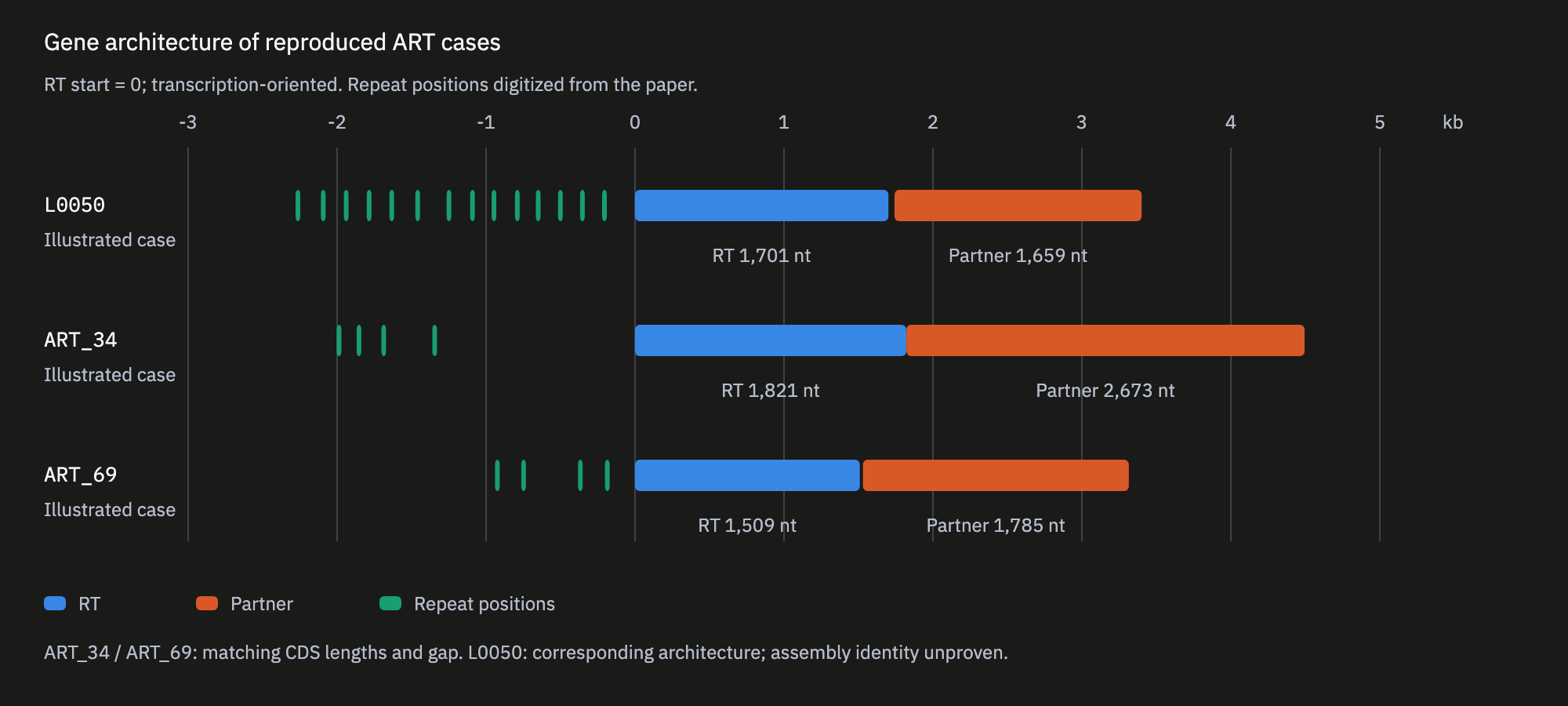
Gene lengths and arrangement were compared together. Repeat positions and gene lengths extracted from the paper’s diagrams are redrawn on a common scale. After harmonizing stop-codon conventions, ART_34 and ART_69 matched in RT and partner coding-sequence lengths and the gap between them. L0050 is a sequence-and-architecture correspondence.
The repeat intervals matched in order, too
A matching protein length alone is not enough. When repeat intervals match in sequence, they add information about the identity of the DNA site. We compared this ordered spacing series as a locus fingerprint.
For ART_34, 3 consecutive intervals matched the diagram-derived values; for ART_69, 3 did. The largest difference between L0050’s observed and diagram-derived interval series was 4 nt. A nucleotide, abbreviated nt, is a unit of DNA length. Diagram-derived coordinates do not have the precision of a direct comparison between complete nucleotide sequences.
We also retained repeats called by our detector beyond those displayed in the diagrams. A matching consecutive subarray and identical calls across the whole array are distinct claims.
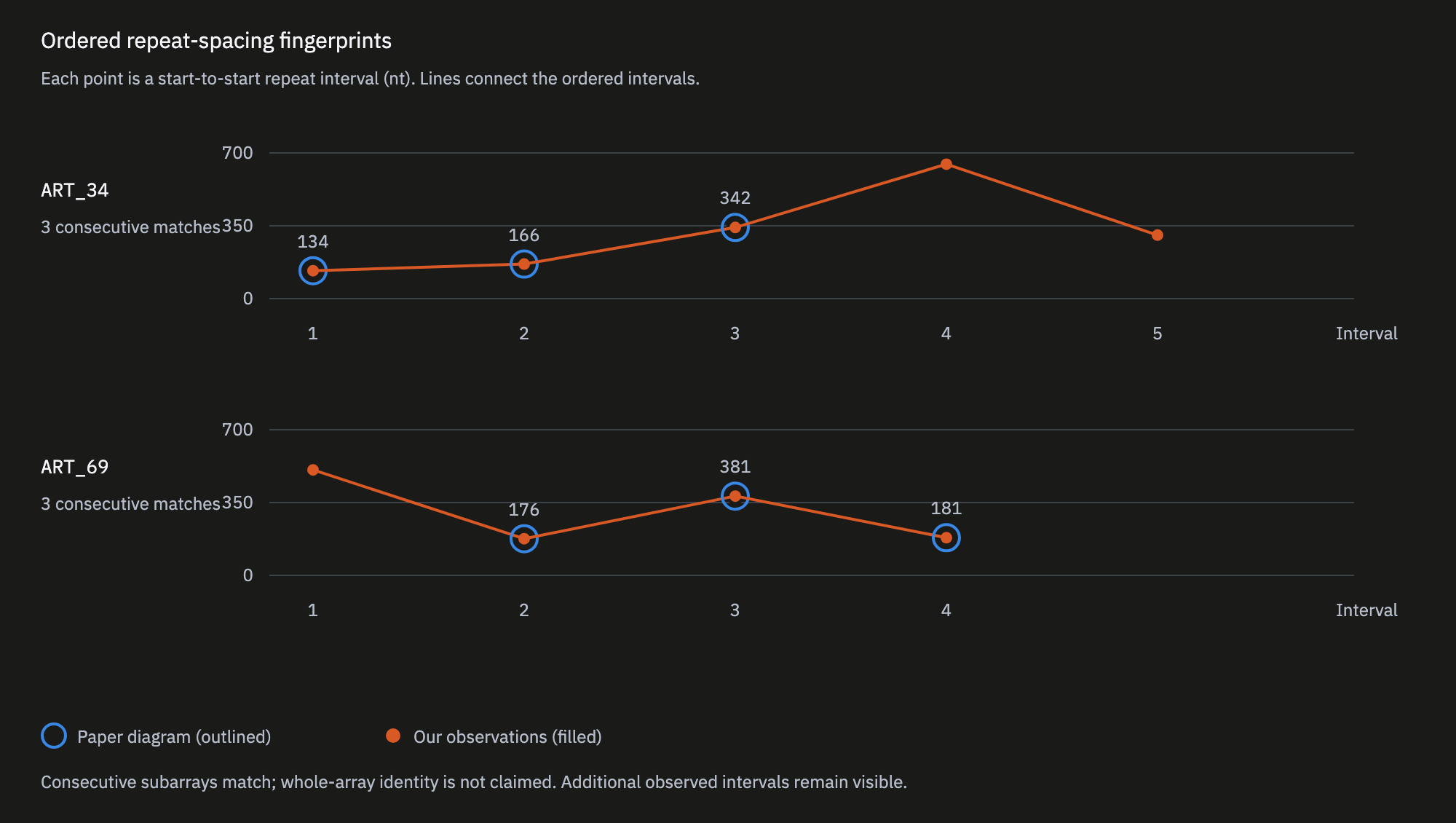
The order of repeat intervals corresponded as well as the lengths. Filled points show our observations; outlines show diagram-derived intervals. Overlapping points mark the consecutive matching segment. Additional observed intervals remain visible.
When the DNA fragment was too short, we returned to the reads
As the search continued, the same obstacle kept appearing: the RT and partner were visible, but there was too little upstream DNA to assess an array.
A contig is a continuous DNA fragment assembled from short sequencing reads. If it ends near the RT, it cannot tell us whether an array is absent or merely lies outside the assembled fragment. Stopping there could leave relevant loci unresolved.
The harness returned to the original reads from each candidate’s source sample. Reads connected to the candidate contig were used to extend the upstream region, after which we reassessed the array. We remapped the reads to the reconstructed sequence to check support from the actual data.
ERR10896470_6887_1 initially had only 232 nt of available upstream sequence. Reconstruction increased that to 3,597 nt, exposing a repeat array. ERR4236129_15347_m increased from 301 nt to 3,585 nt, making array assessment possible.
The harness supplied missing DNA context and turned previously unassessed candidates into assessable results. These are observations on reconstructed cluster-member sequences, not proof that the original cluster representative’s locus was reconstructed identically.
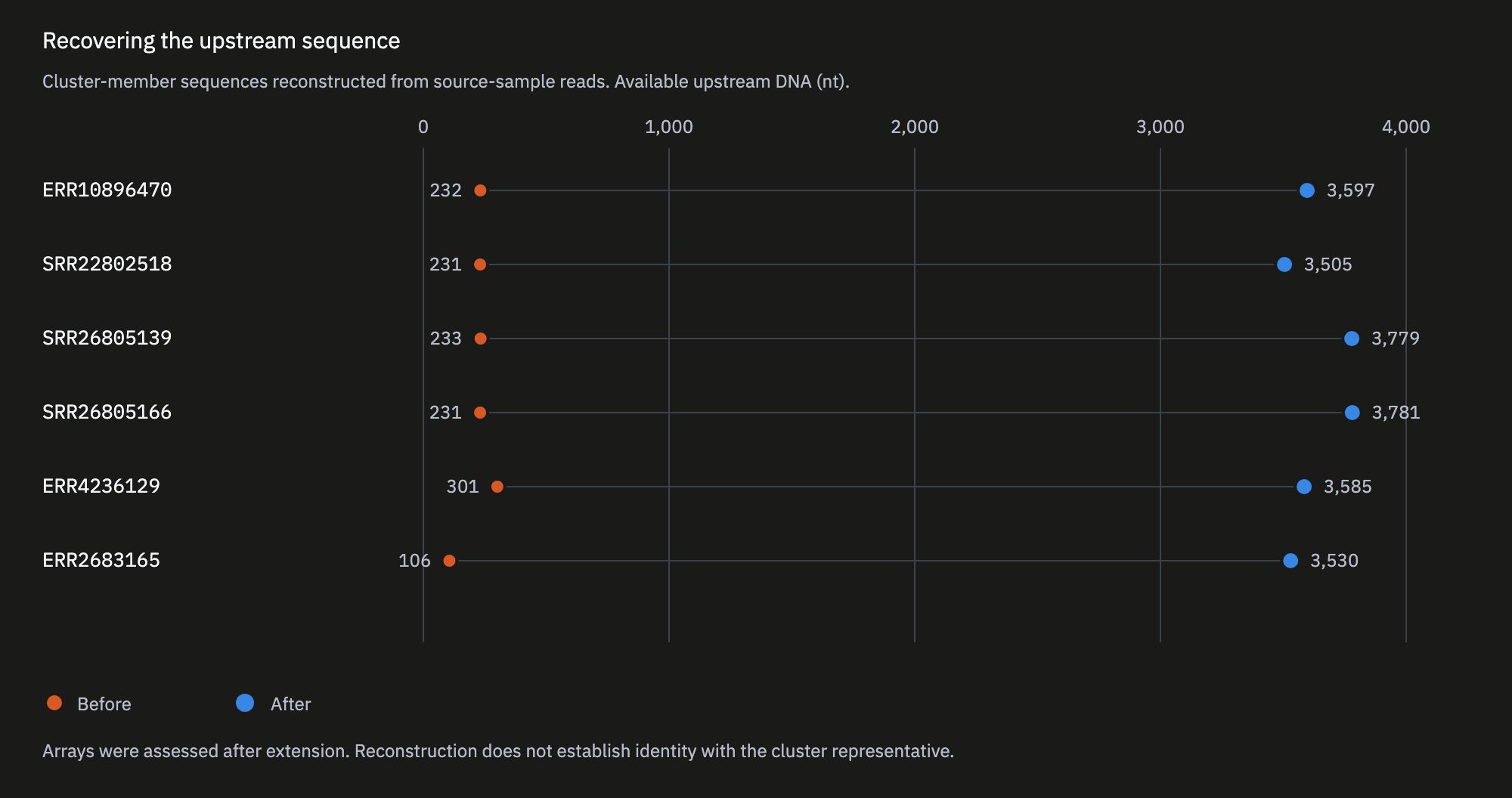
The additional upstream sequence was recovered from reads. Each point comes from the recorded reconstruction outputs. The change was in the available DNA, not a relaxation of the search rules.
Improving the harness brought more illustrated cases into view
Among the reconstructed results, ART_38 corresponded in gene lengths and consecutive repeat spacing, while SA1 was a near correspondence. ART_95 corresponded in spacing but retained a partner-length discrepancy, so it remained suggestive.
| Search stage | Relationship to the paper’s diagrams |
|---|---|
| Initial direct search: 3 results | L0050 sequence-and-architecture correspondence; ART_34 and ART_69 gene-length and interval-fingerprint correspondence |
| Further comparisons after read-supported reconstruction | ART_38 correspondence; SA1 near correspondence; ART_95 suggestive correspondence |
Reaching further published cases showed that improving the harness was useful in practice. Exact, near, and suggestive correspondences were not combined into one confirmed category. These results are reproductions, not counts of new discoveries.
Similar architecture reappeared beyond the displayed fingerprints
Read-supported reconstruction did more than bring published examples into view. In the ERR10896470 lineage, we confirmed an RT, partner, and upstream array together at sites whose fingerprints did not match the paper’s displayed examples.
In the initial completed snapshot, 4 observations in this lineage were classified as strong array evidence. They came from 3 BioProjects. A BioProject groups data from a source research project. Two samples from the same project were not counted as two independent studies.
An array seen in a single assembly could reflect an assembly artifact. Similar repeat intervals and gene context recurring in samples from different studies provide stronger reproduction evidence.
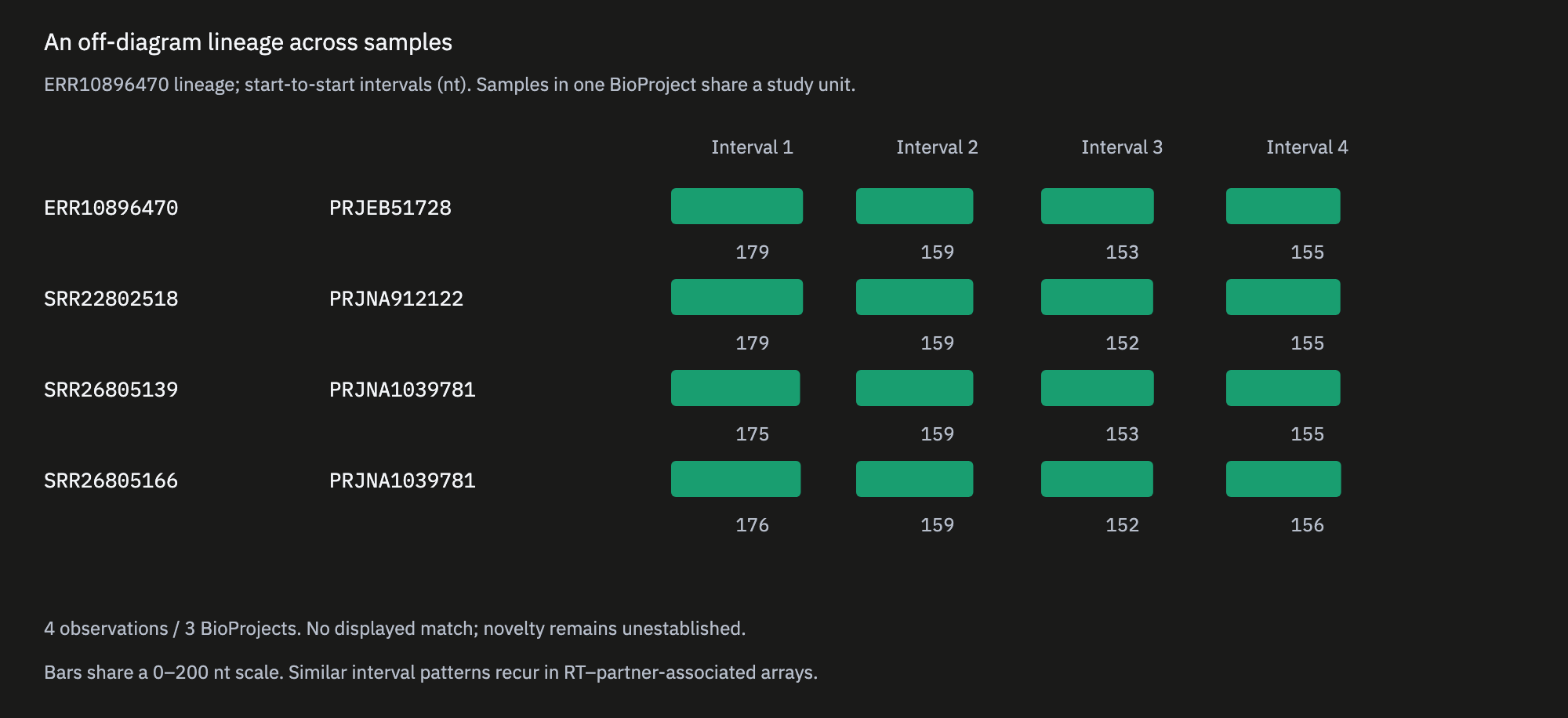
Similar interval series appeared across samples. Sample identifiers and BioProjects are displayed together to distinguish observation counts from study units. Small differences between intervals remain visible.
“Beyond the displayed fingerprints” means that the results did not correspond to the printed sequences and diagram-derived fingerprints we compared. It does not prove that they were absent from every lineage examined in the original paper. We therefore describe additional ART-linked, partner-associated array architectures, without claiming a world-first locus or an established biological function.
What this case demonstrates about the harness
This study went beyond describing a proposed workflow. In public datasets, the harness carried out the following tasks:
- The search reached relevant examples. We compared 3 initial hits with the paper afterward and classified them as reproductions of known cases.
- It inspected and extended DNA context. Arrays that could not be assessed in short contigs were evaluated in sequences reconstructed from the original reads.
- It continued the checks across samples. Strong array evidence in an off-diagram lineage reappeared in multiple BioProjects.
- It preserved evidence categories. Matched cases were reclassified as reproductions; incomplete data and failed analyses were not converted into biological negatives.
AI3 Discovery’s scientific research harness carried out candidate search, DNA-context checks, and read-supported reconstruction in this ART study. Correspondences with published cases showed that the search reached relevant loci. Before-and-after reconstruction results showed that improving the harness made more arrays assessable. Recurrence in samples from different studies added further support. These are concrete results behind the claim that the harness works.
What we checked, and what remains open
We did not recover every illustrated case. In a later, figure-informed sensitivity diagnostic, exact or near recovery was 6/26 within the defined evaluation set. This was a subsequent test, distinct from the initial direct search. The workflow is not established as a complete detector for every ART lineage.
The independence is in the analysis environment and search execution. We used the paper’s public seeds and methods without replicating its entire research environment. No access audit established strict non-viewing of the diagrams. These calculations do not establish array expression, reverse-transcription products, or a role in phage infection. The original researchers’ experimental evidence must be distinguished from our computational results.
A closer look at the evidence
The initial completed read-reconstruction snapshot contained 52 unique candidate IDs. 7 were classified as strong evidence, including results corresponding to published cases. The strong category is therefore not a count of new loci.
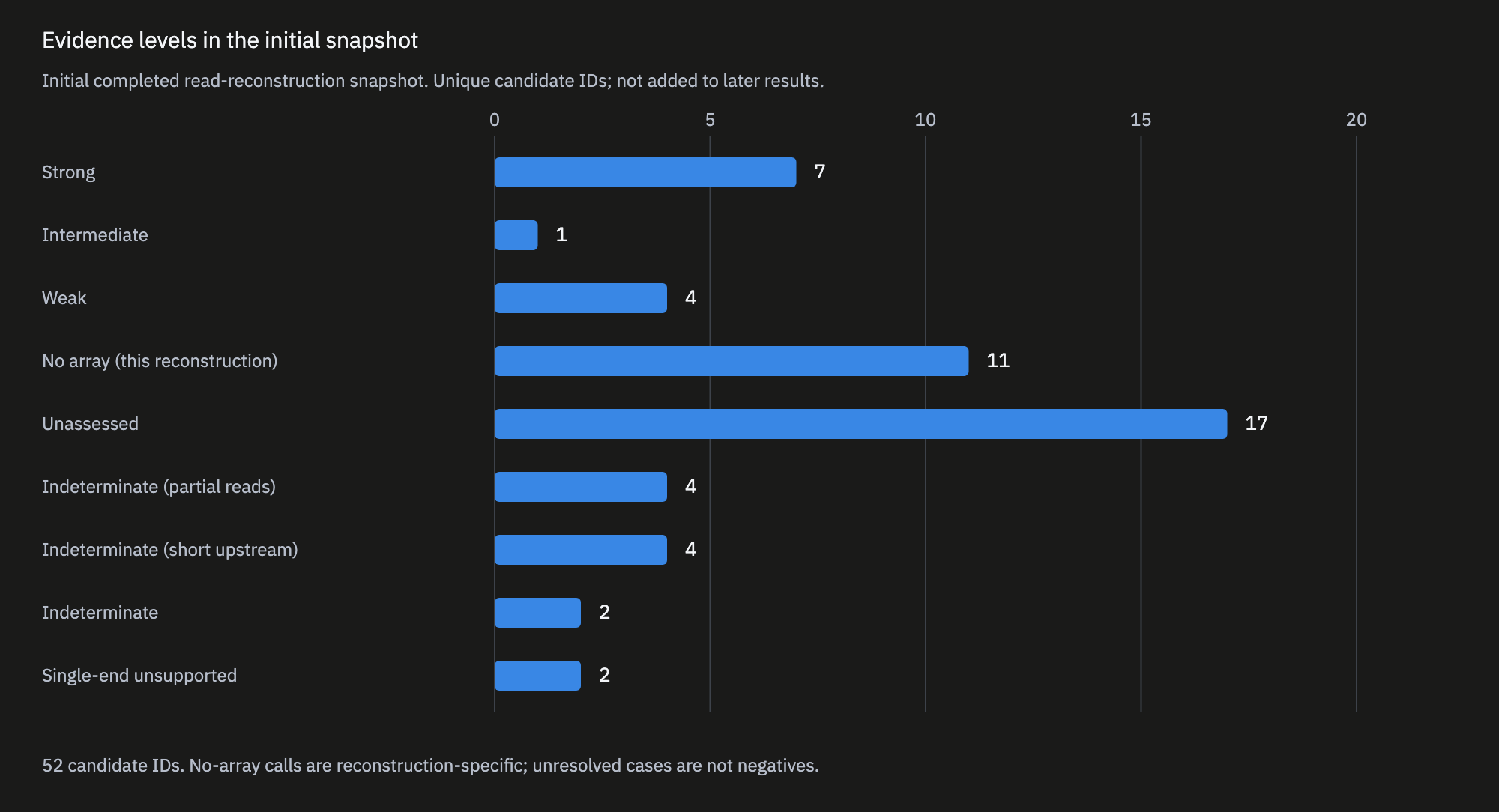
| Evidence category | Unique candidate IDs |
|---|---|
| Strong | 7 |
| Intermediate | 1 |
| Weak | 4 |
| No array (this reconstruction) | 11 |
| Unassessed | 17 |
| Indeterminate (partial reads) | 4 |
| Indeterminate (short upstream) | 4 |
| Indeterminate | 2 |
| Single-end unsupported | 2 |
Unassessed and indeterminate do not mean an array is absent. Even a no-array call is scoped to the particular reconstructed sequence. This is the initial completed snapshot; it is not added to later results.
In a separate follow-up test of ART-linked candidates with insufficient upstream context, arrays were called in all 15 assessable contigs from 8 BioProjects. In this selected sample, the result supports the interpretation that short contigs had concealed arrays.
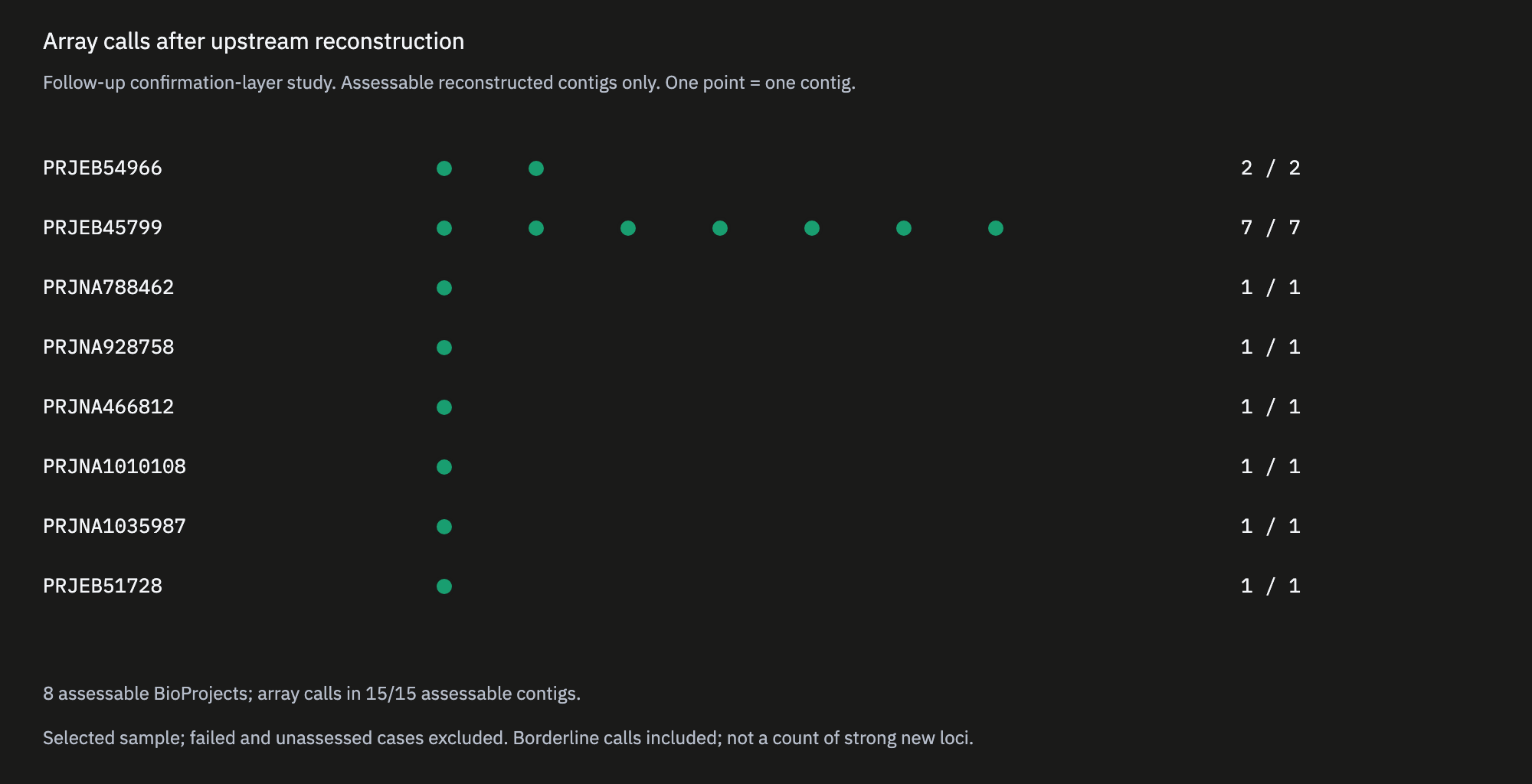
Each point is one assessable contig. Calls include borderline results. Failures, unassessed cases, and untested large-read datasets are outside the denominator. This is not a positivity rate for the entire candidate pool or a count of strongly supported new loci.
Related partner-structure research
In a separate study, we enriched ART partner alignments with public homologues and measured increased prediction confidence against a shuffled-row control. We then compared how different methods read the same predicted structures. Read the research overview and English/Korean PDFs, with checking data for that structure study on Zenodo. The manuscript is self-published and has not undergone independent human peer review. Increased prediction confidence does not establish domain counts or enzyme activity. The data record covers the partner-structure study, not the whole locus-search effort described here.
Sources and research harness
- Yoon PH, Athukoralage JS, Ameisen E, Kauderer-Abrams E, Perry NT, Durrant MG. Autonomous AI agents discover reverse transcriptases with tandem repeat arrays. Original paper · Anthropic’s research announcement.
- GEM: Nayfach et al., A genomic catalog of Earth’s microbiomes.
- Logan: Public sequence-assembly resource.
Figures were generated programmatically from preserved analysis outputs and completed tables. The paper’s diagrams were used for subsequent comparisons and sensitivity diagnostics.
Research harness and AI use. This study used AI3 Discovery’s scientific research harness. It connected AI coding and analysis agents with analysis tools for sequence search, DNA-context checks, read-supported reconstruction, and comparisons of results. Automated checks and AI review do not replace independent human peer review. AI3 Discovery is responsible for the published content.
| Explore scientific research with AI3 Discovery |
|---|
| We welcome researchers and laboratories interested in testing published clues against real data and connecting computational results with experiments. If you have a scientific question, data to investigate, or an experimental direction that could benefit from AI-assisted research, please get in touch. Contact: [email protected] |